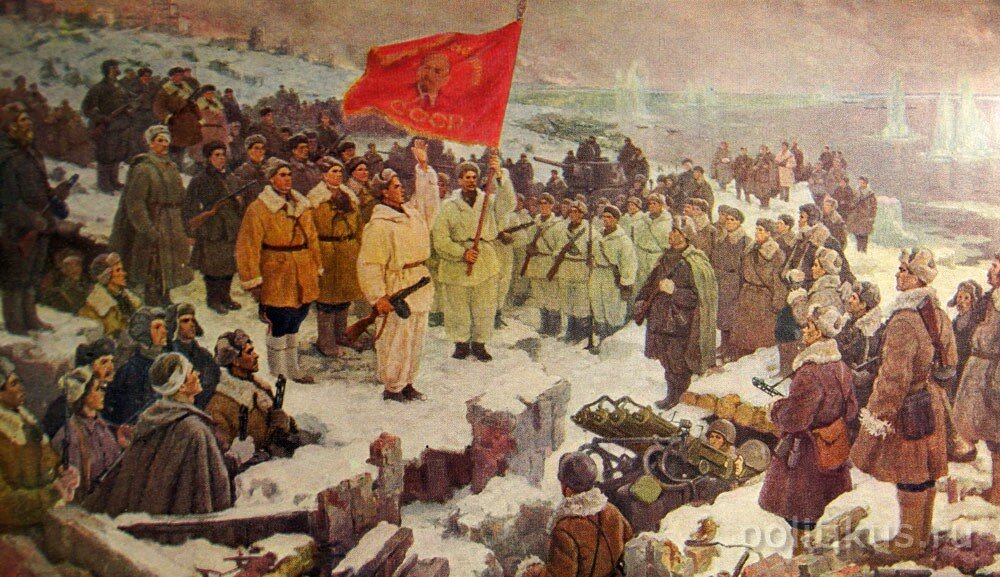
On February 2, we celebrated the 83rd anniversary of victory in the Battle of Stalingrad. Occurring in 1943, it paved the way to the Great Turn when the Red Army gradually gained an advantage against the Fascist forces.
In the summer of 1942, having been evacuated from Borovsk and now fleeing the epidemic of pediculosis that hit the Kirov region in the summer of 1942, my grandmother, her parents, and her younger brother moved to Yaroslavl where her older sister Vera lived with her family. My grandmother recalled that in the winter of 1942-43 they were most afraid of the moment when the Volga would freeze, and if, God forbid, the enemy gained an advantage, they would immediately come to Yaroslavl. Therefore, the operation “Bear”, which had already begun at the time and in which Vera’s husband, the writer Klavdiy Derbenyov, was involved, was not only intended to confuse the enemy, but also to provide Yaroslavl with weapons in case of the severe weather conditions that could hinder the Russian victory.

Yet Stalingrad survived. In October 2025, a panel discussion on preserving historical memory and countering falsification of history was held at the International Cooperation Forum at the National Center “Russia”. I was there, of course. One of the panelists, Rashid Kutbudinovich Alimov, a politician and a diplomat, formerly Permanent Representative of the Republic of Tajikistan to the UN and Ambassador of Tajikistan to China, recalled that a girl named Zina Selezneva was born in the famous Pavlov’s House at the height of the fighting. This was a symbol of eternal Life amidst the horror of Death.
Dmitry Shevarov quotes an adult Zinaida’s account of her birth (as told by her mother):
My grandparents lived in this house. They had a utility room there – they worked as janitors. And when the bombing started, my mother ran to them. My father was taken to the defense of Stalingrad in the spring, he was a worker at the “Red October” plant. His name was Pyotr Pavlovich Seleznev. He didn’t see me. He died without knowing that I was born… There were no doctors, my mother’s sisters helped with the birth. The soldiers gave me their socks for swaddling clothes. The dysentery was terrible, and as soon as I was born, I began to die. They had already dug a grave in the earthen floor, but while they were digging, they found an icon-medallion. As soon as they shook the ground off it, I came back to life.
After the war, Zina was traced by the soldiers who had heroically defended the only surviving house in the city. Everyone considered Zinaida to be their daughter, from the blinded Ivan Afanasyev to the Uzbek soldier Turgunov who certified in the village council that Zinaida Selezneva was indeed born in the Pavlov House. Finally, Yuri Vizbor, who visited Stalingrad-Volgograd in the 1970s, helped to improve the living conditions of Zinaida and her mother.

Rashid Alimov emphasized the importance of such stories in preserving the living memory of our people’s heroic deeds. I disagree that the Russian people are multi-ethnic, but the USSR was multi-ethnic indeed, and it was opposed by a powerful Reich supported by almost all of Europe. The history of the Battle of Stalingrad tells us not only about “friendship among nations” but about genuine cooperation at war and at peace.
It was in Stalingrad that “Madame Penicillin“, Zinaida Yermolyeva, developed a Soviet antibiotic. After all, foreign partners could not provide it for free. In terrible conditions, under regular bombing, Yermolyeva fulfilled her medical and human duty. The outstanding writer Veniamin Kaverin wrote the trilogy “The Open Book” about this outstanding woman.
Now that I’m writing this, I feel like we’ve been too focused on what was outside the “Iron Curtain” for the past 30 years, and we’ve completely forgotten (or maybe even never knew) that there are great works of fiction that surpass foreign business books by immersing the reader in partially fictional circumstances, allowing them to follow the journey of a hero or heroine and find solutions to their “modern-day issues.” I’ve always found the novel “How the Steel Was Tempered” difficult to read, but I’ve read “Two Captains” and watched its adaptation countless times. I admit that “The Open Book” is still a mystery to me, but I believe it can be recommended to young girls and women. This is a story of dedication to one’s profession and one’s homeland, with its most vivid and dramatic moments unfolding during the Battle of Stalingrad.
I would like to congratulate all my readers who lived and still live in Volgograd-Stalingrad on the anniversary of your city’s heroic deeds.
More posts On Russia.


